Sale Price:
$4,320.00
Original Price:
$4,800.00
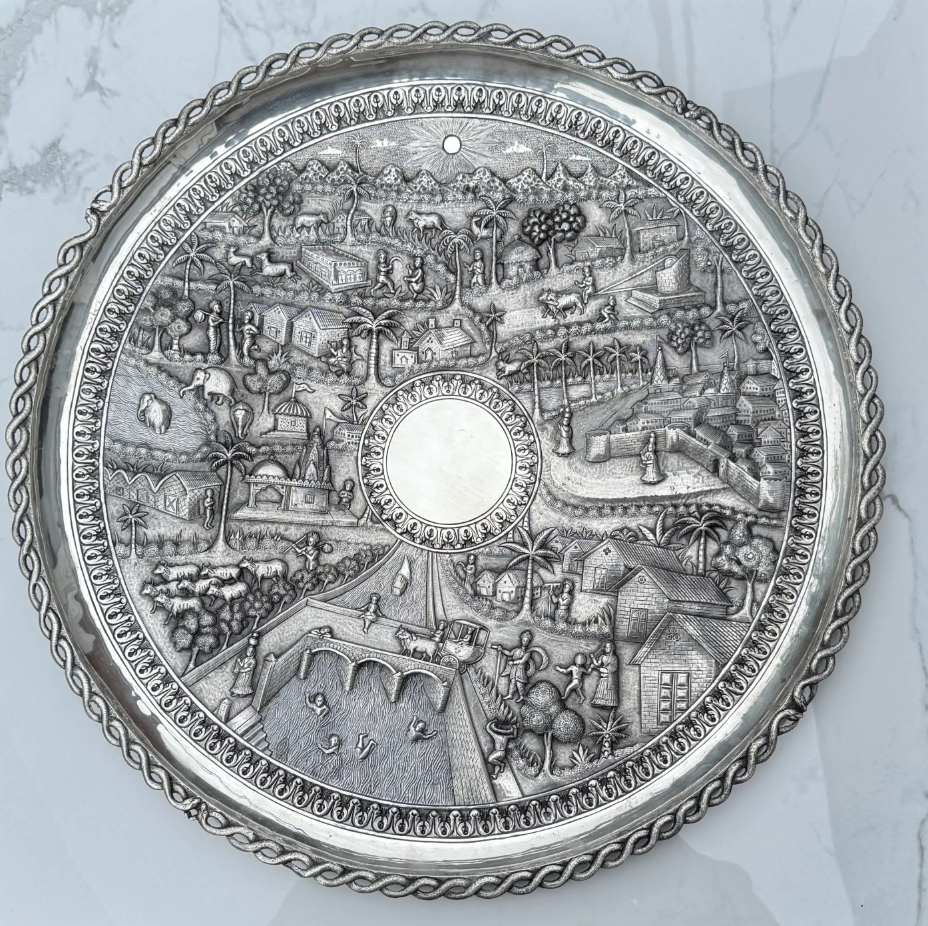
An exceptionally large and masterfully executed Anglo-Indian silver tray, almost certainly produced in Calcutta, Bengal Presidency, circa 1880s. This piece is among the largest known examples of colonial Indian figural silver.
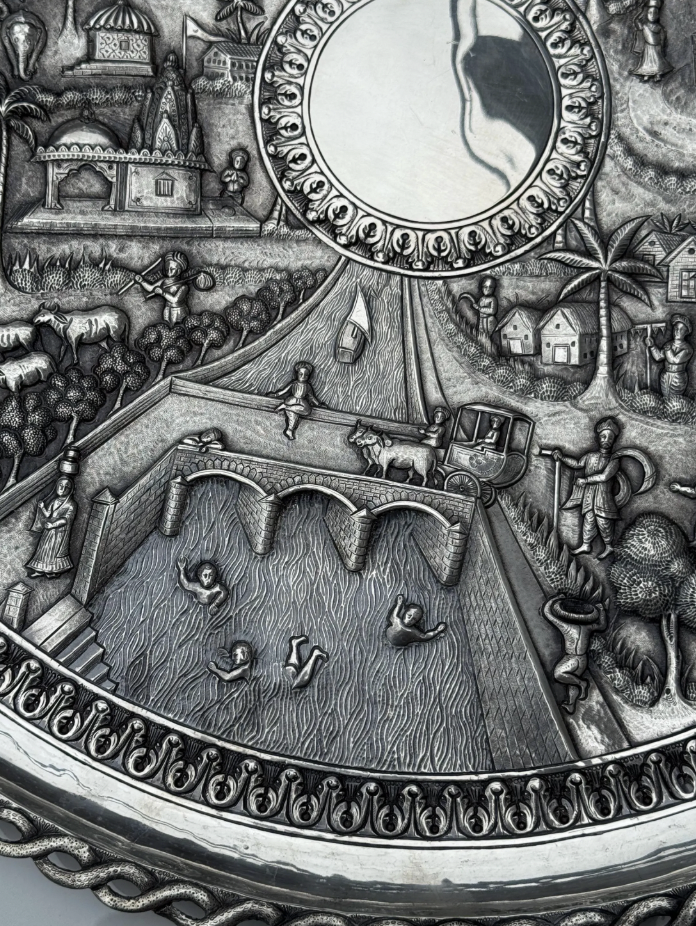
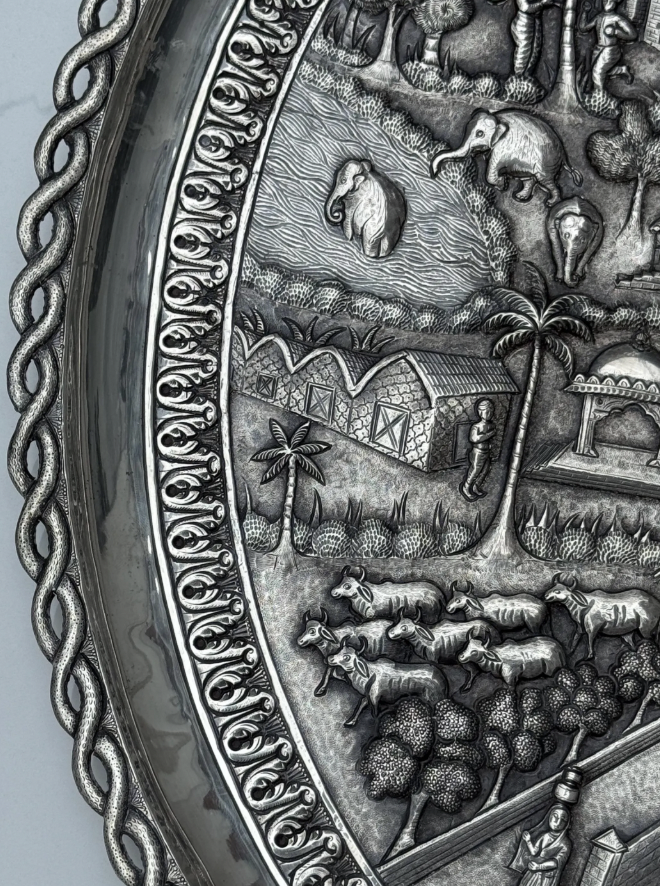
The surface is finely repoussé with a panoramic narrative of rural Bengali life, centered on a dramatic stone bridge spanning The Sacred Ganges, beneath which several figures are depicted swimming—an unusually animated and joyful scene for Indian silver of this period. Atop the bridge, a bullock cart travels alongside a turbaned gentleman. Other vignettes include paddy harvesting, temples, domestic life, and a sprawling walled city or palace complex nestled into the hills—perhaps referencing Murshidabad or parts of old Calcutta.
Such topographical, humanistic silverwork is distinctly Calcutta in origin, in contrast to the more stylized floral or bazaar-driven motifs of the Bombay or Madras schools. Calcutta silversmiths were known for capturing documentary detail, often reflecting the life of the Ganges basin and the colonial encounter. The presence of two integral suspension rings to the reverse further supports its likely use as a presentation or wall-mounted prestige object, perhaps gifted or displayed in a colonial residence or club.
Surviving examples of this scale and clarity are exceedingly rare, with most 19th-century Indian chargers typically under 16 inches and rarely approaching this narrative and architectural sophistication.
Unmarked, as is often the case with Indian silver of the period, but clearly the work of a highly skilled Bengali workshop.
A museum-worthy survivor.
Dimensions: 20.75" across
Weight: 1,800+ grams
Reach out with questions.
Check out some of my other sterling Indian silver here:
www.dcsilvershop.com
An exceptionally large and masterfully executed Anglo-Indian silver tray, almost certainly produced in Calcutta, Bengal Presidency, circa 1880s. This piece is among the largest known examples of colonial Indian figural silver.
The surface is finely repoussé with a panoramic narrative of rural Bengali life, centered on a dramatic stone bridge spanning The Sacred Ganges, beneath which several figures are depicted swimming—an unusually animated and joyful scene for Indian silver of this period. Atop the bridge, a bullock cart travels alongside a turbaned gentleman. Other vignettes include paddy harvesting, temples, domestic life, and a sprawling walled city or palace complex nestled into the hills—perhaps referencing Murshidabad or parts of old Calcutta.
Such topographical, humanistic silverwork is distinctly Calcutta in origin, in contrast to the more stylized floral or bazaar-driven motifs of the Bombay or Madras schools. Calcutta silversmiths were known for capturing documentary detail, often reflecting the life of the Ganges basin and the colonial encounter. The presence of two integral suspension rings to the reverse further supports its likely use as a presentation or wall-mounted prestige object, perhaps gifted or displayed in a colonial residence or club.
Surviving examples of this scale and clarity are exceedingly rare, with most 19th-century Indian chargers typically under 16 inches and rarely approaching this narrative and architectural sophistication.
Unmarked, as is often the case with Indian silver of the period, but clearly the work of a highly skilled Bengali workshop.
A museum-worthy survivor.
Dimensions: 20.75" across
Weight: 1,800+ grams
Reach out with questions.
Check out some of my other sterling Indian silver here:
www.dcsilvershop.com